

509th Tactical Fighter Squadron Patch –With hook and loop
509th Tactical Fighter Squadron Patch –With hook and loop
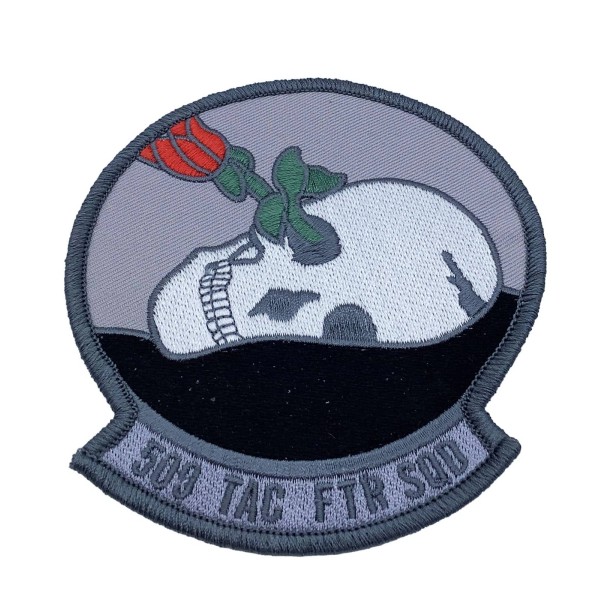


509th Tactical Fighter Squadron Patch –With hook and loop
Product Overview
509th Tactical Fighter Squadron Patch -With hook and loop
A 9.5W x 10.7H cm(as 4") squadron patch of the 509th Tactical Fighter Squadron with hook and loop.
The 509th Tactical Fighter Squadron is an inactive United States Air Force unit. It was last assigned to the 10th Tactical Fighter Wing at RAF Alconbury, England, where it was inactivated on 30 December 1992.
The squadron was first activated as the 624th Bombardment Squadron in 1943, changing to the 509th Fighter-Bomber Squadron a few months later. After training in the United States, it moved to England in March 1944, helping prepare for Operation Overlord by attacking targets in France. Following D-Day, the squadron moved to the continent, providing close air support for Allied forces. The squadron earned a Distinguished Unit Citation and was cited in the Order of the Day by the Belgian Army. After V-E Day The squadron returned to the United States and was inactivated at the port of embarkation.
The squadron was activated again in 1952, when it replaced an Air National Guard squadron that had been mobilized for the Korean War. It trained for fighter bomber operations until inactivating in 1958. A year later, it was activated in the Philippines as the 509th Fighter-Interceptor Squadron with an air defense mission. It deployed interceptor aircraft to Taiwan and from 1962 to 1969 maintained detachments in Vietnam.
The squadron was inactivated in 1970, but returned in England in 1979.
History
World War II
The squadron was originally activated at Drew Field, Florida on 1 March 1943 as the 624th Bombardment Squadron, one of the four original squadrons of the 405th Bombardment Group. It was initially equipped with Douglas A-24 Banshees and Bell P-39 Airacobras. Although retaining the same mission and equipment, in August the squadron was renamed the 509th Fighter-Bomber Squadron. The following month, it moved to Walterboro Army Air Field, South Carolina, where it began to fly the Republic P-47 Thunderbolts, with which it would be equipped for the rest of World War II. On 14 February 1944, the 509th left its training base for the European Theater of Operations.
The squadron arrived at its first station in the theater, RAF Christchurch, England in early March 1944 and flew its first combat mission the following month. It dropped the "bomber" portion of its designation in May, but retained the fighter bomber mission. The 509th helped prepare for Operation Overlord, the invasion of Normandy, by striking military airfields, and lines of communication, particularly bridges and railroad marshalling yards. On D-Day, it flew combat patrols in the vicinity of Brest, France, and in the following days flew armed reconnaissance missions over Normandy.[3]
Toward the end of June, the squadron moved to Picauville Airfield, France, and for the rest of the war concentrated on providing close air support for ground forces. It supported Operation Cobra, the breakout at Saint Lo in July with attacks on military vehicles and artillery positions. The squadron engaged and destroyed a German armored column near Avranches, France, on 29 July 1944. After immobilizing leading and trailing elements of the 3-mile (4.8 km) long column, the rest of the tanks and trucks were systematically destroyed with multiple sorties.[4] Its operations from D-Day through September 1944 supporting the liberation of Belgium earned the squadron a citation in the Order of the Day of the Belgian Army. The squadron received a Distinguished Unit Citation for action on 24 September 1944 when the 4th Armored Division experienced a counterattack by enemy forces and urgently needed air support. Elements of the 405th Group attacked the enemy armor despite an 800-foot ceiling that forced attacks to be made from low level in the face of intense flak. A second group element was unable to locate the tank battle because of the adverse weather, but located a reinforcing column of armor and trucks, causing major damage. A third element attacked warehouses and other buildings in the vicinity that were being used by the enemy.[3][note 2]
The squadron flew its last combat mission of the war on 8 May 1945. It briefly served in the occupation forces at AAF Station Straubing, but by 8 July was mostly a paper unit. Its remaining personnel returned to the United States in October and the squadron was inactivated upon arrival at the port of embarkation.[1][3]
Reactivation as a fighter bomber unit
The squadron returned to its designation as the 509th Fighter-Bomber Squadron and was activated at Godman Air Force Base, Kentucky on 1 December 1952, when it assumed the mission, personnel and F-47 Thunderbolt aircraft of the 141st Fighter-Bomber Squadron, a New Jersey Air National Guard unit that had been called to active duty for the Korean War. However, Godman was not suitable for jet fighter operations, and in April 1953, the squadron moved to Langley Air Force Base, Virginia[1] as the Air Force prepared to transfer Godman to the Army. After arriving at Langley, the squadron was able to upgrade to Republic F-84 Thunderjets, later upgrading to North American F-100 Super Sabres. The squadron was inactivated with the rest of the 405th Wing in July 1958.[1][5]
Air defense in the Pacific
The squadron was redesignated the 509th Fighter-Interceptor Squadron and activated in April 1959, when the 405th Fighter Wing replaced the 6200th Air Base Wing at Clark Air Base, Philippines. The squadron assumed the mission, personnel and North American F-86D Sabres of the 26th Fighter-Interceptor Squadron, which was simultaneously inactivated.[1][6] The following year, the squadron replaced its Sabres with Convair F-102 Delta Daggers, which were armed with AIM-4 Falcons and equipped with data link for intercept control.[1][5]
The squadron mission was air defense of the Philippines, but as the only USAF interceptor unit in the southern Pacific, the squadron was called on to deploy elements to other countries.[5] One of the earliest deployments was to Don Muang Airport outside Bangkok, Thailand of six F-102s under Operation Bell Tone.[7] It also deployed to Taiwan. In March 1962, the American radar unit at Pleiku Air Base began to detect unknown aircraft entering South Vietnamese airspace. In response, the squadron sent a detachment of four "Deuces" to Tan Son Nhut Airport, near Saigon. One was a two-seat TF-102, which proved better at intercepting the slow-moving aircraft used for training to simulate the intruders. As a result, more TF-102s were drawn from Fifth and Thirteenth Air Forces for the detachment. In July, the squadron's planes were replaced by Navy Douglas AD-5Q Q-Birds, and the Air Force and Navy began a series of six-week rotations for air defense in Vietnam.
The Gulf of Tonkin Incident resulted in another deployment of squadron interceptors to Vietnam. On 5 August 1964, six F-102s deployed from Clark to Da Nang Air Base in the northern part of South Vietnam.[9] By the end of 1966, the squadron was maintaining six planes on alert at Bien Hoa Air Base in addition to the six at Da Nang, with another ten located in Thailand at Don Muang and at Udorn Royal Thai Air Force Base. After June 1966, the detachments in Thailand were maintained jointly with the 64th Fighter-Interceptor Squadron, which had been activated as a second F-102 unit at Clark.[10][11] Fourteen aircraft were kept on five-minute alert, while the rest were expected to respond within an hour. Missions included providing top cover for Boeing B-52 Stratofortresses engaged in Operation Arc Light missions. This alert commitment lasted until December 1969, and 15 F-102s were lost during Southeast Asia operations.[12] The squadron's detachments in Thailand were closed under Projects Banner Star and Banner Sun and their planes returned to Clark.[11] The squadron became nonoperational on 17 July 1970 and was inactivated a week later with the phaseout of the F-102 in the Pacific.[5][13]
Tactical fighter operations in Europe
The squadron was again redesignated, this time as the 509th Tactical Fighter Squadron and activated at RAF Woodbridge, England in October 1979 as the 81st Tactical Fighter Wing changed its mission to close air support and air interdiction as it equipped with Fairchild Republic A-10 Thunderbolt IIs and expanded from three to six operational squadrons.[14] Four months later, the squadron moved to the 81st Wing's main base at RAF Bentwaters. The squadron participated in joint and combined exercises with American and British ground forces and periodically deployed to designated wartime operating bases at RAF Ahlhorn and Norvenich Air Base in Germany.[14]
In June 1988, the squadron moved to RAF Alconbury, where it was assigned to the 10th Tactical Fighter Wing. The squadron continued the same mission until inactivating in late December 1992 as the US reduced its presence in the United Kingdom.[15]
Lineage
Constituted as the 624th Bombardment Squadron (Dive) on 4 February 1943
Activated on 1 March 1943
Redesignated 509th Fighter-Bomber Squadron on 10 August 1943
Redesignated 509th Fighter Squadron on 30 May 1944
Inactivated on 15 October 1945
Redesignated 509th Fighter-Bomber Squadron on 15 October 1952
Activated on 1 December 1952
Inactivated on 1 July 1958
Redesignated 509th Fighter-Interceptor Squadron on 11 March 1959
Activated on 9 April 1959[16]
Inactivated on 24 July 1970
Redesignated 509th Tactical Fighter Squadron on 30 April 1979
Activated on 1 October 1979[17]
Inactivated on 30 December 1992[18]
Assignments
405th Bombardment Group (later 405th Fighter-Bomber Group, 405th Fighter Group), 1 March 1943 - 15 October 1945
405th Fighter-Bomber Group, 1 December 1952
405th Fighter-Bomber Wing, 8 October 1957 - 1 July 1958
405th Fighter Wing, 9 April 1959 - 24 July 1970[5][16] (attached to 23d Air Base Group 5 August 1964 - 8 July 1965, 6252d Tactical Fighter Wing 8 July-November 1965)
81st Tactical Fighter Wing, 1 October 1979[14]
10th Tactical Fighter Wing, 1 September 1988 - 30 December 1992[15]
Stations
Drew Field, Florida, 1 March 1943
Walterboro Army Air Field, South Carolina, 14 September 1943 - 14 February 1944
RAF Christchurch (AAF-416),[19] England, 7 March-22 June 1944
Picauville Airfield (A-8),[20] France, 29 June 1944
St-Dizier Airfield (A-64),[20] France, c. 13 September 1944
Ophoven Airfield (Y-32),[20] Belgium, 6 February 1945
Kitzingen Airfield (R-6),[20] Germany, 23 April 1945
AAF Station Straubing (R-68),[20] Germany, 8 May-2 July 1945
Camp Shanks, New York, 14-15 October 1945
Godman Air Force Base, Kentucky, 1 December 1952
Langley Air Force Base, Virginia, 17 April 1953 - 1 July 1958
Clark Air Base, Philippines, 9 April 1959 - 24 July 1970[21][22]
; Deployed to Kung Kuan Air Base, Taiwan, 1 August - 30 September 1961
RAF Woodbridge, England, 1 October 1979[14]
RAF Bentwaters, England, 1 February 1980[14]
RAF Alconbury, England, 1 June 1988 - 30 December 1992[18]
Aircraft
Douglas A-24 Banshee, 1943
Bell P-39 Airacobra, 1943
Republic P-47 Thunderbolt (later F-47), 1943-1945, 1952[5]
Republic F-84 Thunderjet, 1953-1956
North American F-100 Super Sabre, 1956-1958
North American F-86D Sabre, 1959-1960
Convair F-102 Delta Dagger, 1960-1970[16][5]
Fairchild Republic A-10 Thunderbolt II, 1979-1992
| Isin: | IJ2ZXQXP2EH4 |
|---|
Out of Stock
In Stock
Backordered
Out of Stock


IBspot Buyer Protection
Shop confidently on IBspot, receive your item as described or your money back for eligible orders. Learn Program Terms
Product Overview
509th Tactical Fighter Squadron Patch -With hook and loop
A 9.5W x 10.7H cm(as 4") squadron patch of the 509th Tactical Fighter Squadron with hook and loop.
The 509th Tactical Fighter Squadron is an inactive United States Air Force unit. It was last assigned to the 10th Tactical Fighter Wing at RAF Alconbury, England, where it was inactivated on 30 December 1992.
The squadron was first activated as the 624th Bombardment Squadron in 1943, changing to the 509th Fighter-Bomber Squadron a few months later. After training in the United States, it moved to England in March 1944, helping prepare for Operation Overlord by attacking targets in France. Following D-Day, the squadron moved to the continent, providing close air support for Allied forces. The squadron earned a Distinguished Unit Citation and was cited in the Order of the Day by the Belgian Army. After V-E Day The squadron returned to the United States and was inactivated at the port of embarkation.
The squadron was activated again in 1952, when it replaced an Air National Guard squadron that had been mobilized for the Korean War. It trained for fighter bomber operations until inactivating in 1958. A year later, it was activated in the Philippines as the 509th Fighter-Interceptor Squadron with an air defense mission. It deployed interceptor aircraft to Taiwan and from 1962 to 1969 maintained detachments in Vietnam.
The squadron was inactivated in 1970, but returned in England in 1979.
History
World War II
The squadron was originally activated at Drew Field, Florida on 1 March 1943 as the 624th Bombardment Squadron, one of the four original squadrons of the 405th Bombardment Group. It was initially equipped with Douglas A-24 Banshees and Bell P-39 Airacobras. Although retaining the same mission and equipment, in August the squadron was renamed the 509th Fighter-Bomber Squadron. The following month, it moved to Walterboro Army Air Field, South Carolina, where it began to fly the Republic P-47 Thunderbolts, with which it would be equipped for the rest of World War II. On 14 February 1944, the 509th left its training base for the European Theater of Operations.
The squadron arrived at its first station in the theater, RAF Christchurch, England in early March 1944 and flew its first combat mission the following month. It dropped the "bomber" portion of its designation in May, but retained the fighter bomber mission. The 509th helped prepare for Operation Overlord, the invasion of Normandy, by striking military airfields, and lines of communication, particularly bridges and railroad marshalling yards. On D-Day, it flew combat patrols in the vicinity of Brest, France, and in the following days flew armed reconnaissance missions over Normandy.[3]
Toward the end of June, the squadron moved to Picauville Airfield, France, and for the rest of the war concentrated on providing close air support for ground forces. It supported Operation Cobra, the breakout at Saint Lo in July with attacks on military vehicles and artillery positions. The squadron engaged and destroyed a German armored column near Avranches, France, on 29 July 1944. After immobilizing leading and trailing elements of the 3-mile (4.8 km) long column, the rest of the tanks and trucks were systematically destroyed with multiple sorties.[4] Its operations from D-Day through September 1944 supporting the liberation of Belgium earned the squadron a citation in the Order of the Day of the Belgian Army. The squadron received a Distinguished Unit Citation for action on 24 September 1944 when the 4th Armored Division experienced a counterattack by enemy forces and urgently needed air support. Elements of the 405th Group attacked the enemy armor despite an 800-foot ceiling that forced attacks to be made from low level in the face of intense flak. A second group element was unable to locate the tank battle because of the adverse weather, but located a reinforcing column of armor and trucks, causing major damage. A third element attacked warehouses and other buildings in the vicinity that were being used by the enemy.[3][note 2]
The squadron flew its last combat mission of the war on 8 May 1945. It briefly served in the occupation forces at AAF Station Straubing, but by 8 July was mostly a paper unit. Its remaining personnel returned to the United States in October and the squadron was inactivated upon arrival at the port of embarkation.[1][3]
Reactivation as a fighter bomber unit
The squadron returned to its designation as the 509th Fighter-Bomber Squadron and was activated at Godman Air Force Base, Kentucky on 1 December 1952, when it assumed the mission, personnel and F-47 Thunderbolt aircraft of the 141st Fighter-Bomber Squadron, a New Jersey Air National Guard unit that had been called to active duty for the Korean War. However, Godman was not suitable for jet fighter operations, and in April 1953, the squadron moved to Langley Air Force Base, Virginia[1] as the Air Force prepared to transfer Godman to the Army. After arriving at Langley, the squadron was able to upgrade to Republic F-84 Thunderjets, later upgrading to North American F-100 Super Sabres. The squadron was inactivated with the rest of the 405th Wing in July 1958.[1][5]
Air defense in the Pacific
The squadron was redesignated the 509th Fighter-Interceptor Squadron and activated in April 1959, when the 405th Fighter Wing replaced the 6200th Air Base Wing at Clark Air Base, Philippines. The squadron assumed the mission, personnel and North American F-86D Sabres of the 26th Fighter-Interceptor Squadron, which was simultaneously inactivated.[1][6] The following year, the squadron replaced its Sabres with Convair F-102 Delta Daggers, which were armed with AIM-4 Falcons and equipped with data link for intercept control.[1][5]
The squadron mission was air defense of the Philippines, but as the only USAF interceptor unit in the southern Pacific, the squadron was called on to deploy elements to other countries.[5] One of the earliest deployments was to Don Muang Airport outside Bangkok, Thailand of six F-102s under Operation Bell Tone.[7] It also deployed to Taiwan. In March 1962, the American radar unit at Pleiku Air Base began to detect unknown aircraft entering South Vietnamese airspace. In response, the squadron sent a detachment of four "Deuces" to Tan Son Nhut Airport, near Saigon. One was a two-seat TF-102, which proved better at intercepting the slow-moving aircraft used for training to simulate the intruders. As a result, more TF-102s were drawn from Fifth and Thirteenth Air Forces for the detachment. In July, the squadron's planes were replaced by Navy Douglas AD-5Q Q-Birds, and the Air Force and Navy began a series of six-week rotations for air defense in Vietnam.
The Gulf of Tonkin Incident resulted in another deployment of squadron interceptors to Vietnam. On 5 August 1964, six F-102s deployed from Clark to Da Nang Air Base in the northern part of South Vietnam.[9] By the end of 1966, the squadron was maintaining six planes on alert at Bien Hoa Air Base in addition to the six at Da Nang, with another ten located in Thailand at Don Muang and at Udorn Royal Thai Air Force Base. After June 1966, the detachments in Thailand were maintained jointly with the 64th Fighter-Interceptor Squadron, which had been activated as a second F-102 unit at Clark.[10][11] Fourteen aircraft were kept on five-minute alert, while the rest were expected to respond within an hour. Missions included providing top cover for Boeing B-52 Stratofortresses engaged in Operation Arc Light missions. This alert commitment lasted until December 1969, and 15 F-102s were lost during Southeast Asia operations.[12] The squadron's detachments in Thailand were closed under Projects Banner Star and Banner Sun and their planes returned to Clark.[11] The squadron became nonoperational on 17 July 1970 and was inactivated a week later with the phaseout of the F-102 in the Pacific.[5][13]
Tactical fighter operations in Europe
The squadron was again redesignated, this time as the 509th Tactical Fighter Squadron and activated at RAF Woodbridge, England in October 1979 as the 81st Tactical Fighter Wing changed its mission to close air support and air interdiction as it equipped with Fairchild Republic A-10 Thunderbolt IIs and expanded from three to six operational squadrons.[14] Four months later, the squadron moved to the 81st Wing's main base at RAF Bentwaters. The squadron participated in joint and combined exercises with American and British ground forces and periodically deployed to designated wartime operating bases at RAF Ahlhorn and Norvenich Air Base in Germany.[14]
In June 1988, the squadron moved to RAF Alconbury, where it was assigned to the 10th Tactical Fighter Wing. The squadron continued the same mission until inactivating in late December 1992 as the US reduced its presence in the United Kingdom.[15]
Lineage
Constituted as the 624th Bombardment Squadron (Dive) on 4 February 1943
Activated on 1 March 1943
Redesignated 509th Fighter-Bomber Squadron on 10 August 1943
Redesignated 509th Fighter Squadron on 30 May 1944
Inactivated on 15 October 1945
Redesignated 509th Fighter-Bomber Squadron on 15 October 1952
Activated on 1 December 1952
Inactivated on 1 July 1958
Redesignated 509th Fighter-Interceptor Squadron on 11 March 1959
Activated on 9 April 1959[16]
Inactivated on 24 July 1970
Redesignated 509th Tactical Fighter Squadron on 30 April 1979
Activated on 1 October 1979[17]
Inactivated on 30 December 1992[18]
Assignments
405th Bombardment Group (later 405th Fighter-Bomber Group, 405th Fighter Group), 1 March 1943 - 15 October 1945
405th Fighter-Bomber Group, 1 December 1952
405th Fighter-Bomber Wing, 8 October 1957 - 1 July 1958
405th Fighter Wing, 9 April 1959 - 24 July 1970[5][16] (attached to 23d Air Base Group 5 August 1964 - 8 July 1965, 6252d Tactical Fighter Wing 8 July-November 1965)
81st Tactical Fighter Wing, 1 October 1979[14]
10th Tactical Fighter Wing, 1 September 1988 - 30 December 1992[15]
Stations
Drew Field, Florida, 1 March 1943
Walterboro Army Air Field, South Carolina, 14 September 1943 - 14 February 1944
RAF Christchurch (AAF-416),[19] England, 7 March-22 June 1944
Picauville Airfield (A-8),[20] France, 29 June 1944
St-Dizier Airfield (A-64),[20] France, c. 13 September 1944
Ophoven Airfield (Y-32),[20] Belgium, 6 February 1945
Kitzingen Airfield (R-6),[20] Germany, 23 April 1945
AAF Station Straubing (R-68),[20] Germany, 8 May-2 July 1945
Camp Shanks, New York, 14-15 October 1945
Godman Air Force Base, Kentucky, 1 December 1952
Langley Air Force Base, Virginia, 17 April 1953 - 1 July 1958
Clark Air Base, Philippines, 9 April 1959 - 24 July 1970[21][22]
; Deployed to Kung Kuan Air Base, Taiwan, 1 August - 30 September 1961
RAF Woodbridge, England, 1 October 1979[14]
RAF Bentwaters, England, 1 February 1980[14]
RAF Alconbury, England, 1 June 1988 - 30 December 1992[18]
Aircraft
Douglas A-24 Banshee, 1943
Bell P-39 Airacobra, 1943
Republic P-47 Thunderbolt (later F-47), 1943-1945, 1952[5]
Republic F-84 Thunderjet, 1953-1956
North American F-100 Super Sabre, 1956-1958
North American F-86D Sabre, 1959-1960
Convair F-102 Delta Dagger, 1960-1970[16][5]
Fairchild Republic A-10 Thunderbolt II, 1979-1992
| Isin: | IJ2ZXQXP2EH4 |
|---|
509th Tactical Fighter Squadron Patch -With hook and loop
A 9.5W x 10.7H cm(as 4") squadron patch of the 509th Tactical Fighter Squadron with hook and loop.
The 509th Tactical Fighter Squadron is an inactive United States Air Force unit. It was last assigned to the 10th Tactical Fighter Wing at RAF Alconbury, England, where it was inactivated on 30 December 1992.
The squadron was first activated as the 624th Bombardment Squadron in 1943, changing to the 509th Fighter-Bomber Squadron a few months later. After training in the United States, it moved to England in March 1944, helping prepare for Operation Overlord by attacking targets in France. Following D-Day, the squadron moved to the continent, providing close air support for Allied forces. The squadron earned a Distinguished Unit Citation and was cited in the Order of the Day by the Belgian Army. After V-E Day The squadron returned to the United States and was inactivated at the port of embarkation.
The squadron was activated again in 1952, when it replaced an Air National Guard squadron that had been mobilized for the Korean War. It trained for fighter bomber operations until inactivating in 1958. A year later, it was activated in the Philippines as the 509th Fighter-Interceptor Squadron with an air defense mission. It deployed interceptor aircraft to Taiwan and from 1962 to 1969 maintained detachments in Vietnam.
The squadron was inactivated in 1970, but returned in England in 1979.
History
World War II
The squadron was originally activated at Drew Field, Florida on 1 March 1943 as the 624th Bombardment Squadron, one of the four original squadrons of the 405th Bombardment Group. It was initially equipped with Douglas A-24 Banshees and Bell P-39 Airacobras. Although retaining the same mission and equipment, in August the squadron was renamed the 509th Fighter-Bomber Squadron. The following month, it moved to Walterboro Army Air Field, South Carolina, where it began to fly the Republic P-47 Thunderbolts, with which it would be equipped for the rest of World War II. On 14 February 1944, the 509th left its training base for the European Theater of Operations.
The squadron arrived at its first station in the theater, RAF Christchurch, England in early March 1944 and flew its first combat mission the following month. It dropped the "bomber" portion of its designation in May, but retained the fighter bomber mission. The 509th helped prepare for Operation Overlord, the invasion of Normandy, by striking military airfields, and lines of communication, particularly bridges and railroad marshalling yards. On D-Day, it flew combat patrols in the vicinity of Brest, France, and in the following days flew armed reconnaissance missions over Normandy.[3]
Toward the end of June, the squadron moved to Picauville Airfield, France, and for the rest of the war concentrated on providing close air support for ground forces. It supported Operation Cobra, the breakout at Saint Lo in July with attacks on military vehicles and artillery positions. The squadron engaged and destroyed a German armored column near Avranches, France, on 29 July 1944. After immobilizing leading and trailing elements of the 3-mile (4.8 km) long column, the rest of the tanks and trucks were systematically destroyed with multiple sorties.[4] Its operations from D-Day through September 1944 supporting the liberation of Belgium earned the squadron a citation in the Order of the Day of the Belgian Army. The squadron received a Distinguished Unit Citation for action on 24 September 1944 when the 4th Armored Division experienced a counterattack by enemy forces and urgently needed air support. Elements of the 405th Group attacked the enemy armor despite an 800-foot ceiling that forced attacks to be made from low level in the face of intense flak. A second group element was unable to locate the tank battle because of the adverse weather, but located a reinforcing column of armor and trucks, causing major damage. A third element attacked warehouses and other buildings in the vicinity that were being used by the enemy.[3][note 2]
The squadron flew its last combat mission of the war on 8 May 1945. It briefly served in the occupation forces at AAF Station Straubing, but by 8 July was mostly a paper unit. Its remaining personnel returned to the United States in October and the squadron was inactivated upon arrival at the port of embarkation.[1][3]
Reactivation as a fighter bomber unit
The squadron returned to its designation as the 509th Fighter-Bomber Squadron and was activated at Godman Air Force Base, Kentucky on 1 December 1952, when it assumed the mission, personnel and F-47 Thunderbolt aircraft of the 141st Fighter-Bomber Squadron, a New Jersey Air National Guard unit that had been called to active duty for the Korean War. However, Godman was not suitable for jet fighter operations, and in April 1953, the squadron moved to Langley Air Force Base, Virginia[1] as the Air Force prepared to transfer Godman to the Army. After arriving at Langley, the squadron was able to upgrade to Republic F-84 Thunderjets, later upgrading to North American F-100 Super Sabres. The squadron was inactivated with the rest of the 405th Wing in July 1958.[1][5]
Air defense in the Pacific
The squadron was redesignated the 509th Fighter-Interceptor Squadron and activated in April 1959, when the 405th Fighter Wing replaced the 6200th Air Base Wing at Clark Air Base, Philippines. The squadron assumed the mission, personnel and North American F-86D Sabres of the 26th Fighter-Interceptor Squadron, which was simultaneously inactivated.[1][6] The following year, the squadron replaced its Sabres with Convair F-102 Delta Daggers, which were armed with AIM-4 Falcons and equipped with data link for intercept control.[1][5]
The squadron mission was air defense of the Philippines, but as the only USAF interceptor unit in the southern Pacific, the squadron was called on to deploy elements to other countries.[5] One of the earliest deployments was to Don Muang Airport outside Bangkok, Thailand of six F-102s under Operation Bell Tone.[7] It also deployed to Taiwan. In March 1962, the American radar unit at Pleiku Air Base began to detect unknown aircraft entering South Vietnamese airspace. In response, the squadron sent a detachment of four "Deuces" to Tan Son Nhut Airport, near Saigon. One was a two-seat TF-102, which proved better at intercepting the slow-moving aircraft used for training to simulate the intruders. As a result, more TF-102s were drawn from Fifth and Thirteenth Air Forces for the detachment. In July, the squadron's planes were replaced by Navy Douglas AD-5Q Q-Birds, and the Air Force and Navy began a series of six-week rotations for air defense in Vietnam.
The Gulf of Tonkin Incident resulted in another deployment of squadron interceptors to Vietnam. On 5 August 1964, six F-102s deployed from Clark to Da Nang Air Base in the northern part of South Vietnam.[9] By the end of 1966, the squadron was maintaining six planes on alert at Bien Hoa Air Base in addition to the six at Da Nang, with another ten located in Thailand at Don Muang and at Udorn Royal Thai Air Force Base. After June 1966, the detachments in Thailand were maintained jointly with the 64th Fighter-Interceptor Squadron, which had been activated as a second F-102 unit at Clark.[10][11] Fourteen aircraft were kept on five-minute alert, while the rest were expected to respond within an hour. Missions included providing top cover for Boeing B-52 Stratofortresses engaged in Operation Arc Light missions. This alert commitment lasted until December 1969, and 15 F-102s were lost during Southeast Asia operations.[12] The squadron's detachments in Thailand were closed under Projects Banner Star and Banner Sun and their planes returned to Clark.[11] The squadron became nonoperational on 17 July 1970 and was inactivated a week later with the phaseout of the F-102 in the Pacific.[5][13]
Tactical fighter operations in Europe
The squadron was again redesignated, this time as the 509th Tactical Fighter Squadron and activated at RAF Woodbridge, England in October 1979 as the 81st Tactical Fighter Wing changed its mission to close air support and air interdiction as it equipped with Fairchild Republic A-10 Thunderbolt IIs and expanded from three to six operational squadrons.[14] Four months later, the squadron moved to the 81st Wing's main base at RAF Bentwaters. The squadron participated in joint and combined exercises with American and British ground forces and periodically deployed to designated wartime operating bases at RAF Ahlhorn and Norvenich Air Base in Germany.[14]
In June 1988, the squadron moved to RAF Alconbury, where it was assigned to the 10th Tactical Fighter Wing. The squadron continued the same mission until inactivating in late December 1992 as the US reduced its presence in the United Kingdom.[15]
Lineage
Constituted as the 624th Bombardment Squadron (Dive) on 4 February 1943
Activated on 1 March 1943
Redesignated 509th Fighter-Bomber Squadron on 10 August 1943
Redesignated 509th Fighter Squadron on 30 May 1944
Inactivated on 15 October 1945
Redesignated 509th Fighter-Bomber Squadron on 15 October 1952
Activated on 1 December 1952
Inactivated on 1 July 1958
Redesignated 509th Fighter-Interceptor Squadron on 11 March 1959
Activated on 9 April 1959[16]
Inactivated on 24 July 1970
Redesignated 509th Tactical Fighter Squadron on 30 April 1979
Activated on 1 October 1979[17]
Inactivated on 30 December 1992[18]
Assignments
405th Bombardment Group (later 405th Fighter-Bomber Group, 405th Fighter Group), 1 March 1943 - 15 October 1945
405th Fighter-Bomber Group, 1 December 1952
405th Fighter-Bomber Wing, 8 October 1957 - 1 July 1958
405th Fighter Wing, 9 April 1959 - 24 July 1970[5][16] (attached to 23d Air Base Group 5 August 1964 - 8 July 1965, 6252d Tactical Fighter Wing 8 July-November 1965)
81st Tactical Fighter Wing, 1 October 1979[14]
10th Tactical Fighter Wing, 1 September 1988 - 30 December 1992[15]
Stations
Drew Field, Florida, 1 March 1943
Walterboro Army Air Field, South Carolina, 14 September 1943 - 14 February 1944
RAF Christchurch (AAF-416),[19] England, 7 March-22 June 1944
Picauville Airfield (A-8),[20] France, 29 June 1944
St-Dizier Airfield (A-64),[20] France, c. 13 September 1944
Ophoven Airfield (Y-32),[20] Belgium, 6 February 1945
Kitzingen Airfield (R-6),[20] Germany, 23 April 1945
AAF Station Straubing (R-68),[20] Germany, 8 May-2 July 1945
Camp Shanks, New York, 14-15 October 1945
Godman Air Force Base, Kentucky, 1 December 1952
Langley Air Force Base, Virginia, 17 April 1953 - 1 July 1958
Clark Air Base, Philippines, 9 April 1959 - 24 July 1970[21][22]
; Deployed to Kung Kuan Air Base, Taiwan, 1 August - 30 September 1961
RAF Woodbridge, England, 1 October 1979[14]
RAF Bentwaters, England, 1 February 1980[14]
RAF Alconbury, England, 1 June 1988 - 30 December 1992[18]
Aircraft
Douglas A-24 Banshee, 1943
Bell P-39 Airacobra, 1943
Republic P-47 Thunderbolt (later F-47), 1943-1945, 1952[5]
Republic F-84 Thunderjet, 1953-1956
North American F-100 Super Sabre, 1956-1958
North American F-86D Sabre, 1959-1960
Convair F-102 Delta Dagger, 1960-1970[16][5]
Fairchild Republic A-10 Thunderbolt II, 1979-1992
- Type: Patch
Processing Time
- We process and ship orders Monday through Friday, excluding holidays.
- Most orders are processed within 1–3 business days, depending on product availability.
- Processing time does not include delivery time, which varies based on your location and the product’s shipping origin.
Shipping Coverage
We currently ship to addresses within the United States only.
Products may ship from:
- Our U.S. warehouses, or
- Our international fulfillment centers (including Korea, Japan, China, Australia, Mexico, Canada, the United Kingdom, and the EU).
Each product page clearly displays the “Ships From” location before checkout.
Shipping Methods & Estimated Delivery
| Shipping Method | Estimated Delivery | Cost |
|---|---|---|
| Free Shipping (US) | 5–10 business days | Free, available on eligible items |
| Standard Shipping (US to US by Item) | 5–10 business days | $6.50 for the first item, $2.00 each additional |
| Standard Shipping (From US Warehouse by Weight) | 3–7 business days | Starts at $6.50, increasing by $2 for every additional 4 oz (0.25 lb) up to 1 lb, then by $4 for each additional pound beyond 1 lb. |
| Extended Delivery (Ships from Overseas Warehouse) | 10–20 business days | $14.50 for the first item, $2.00 each additional |
Shipping costs vary by product weight, quantity and origin. Exact rates and delivery estimates are displayed on each product page and confirmed during checkout.
Free Shipping
We offer free standard shipping on select products or during promotional periods. Availability of free shipping will be displayed on the product page and at checkout.
Carriers
We primarily use USPS and UPS for U.S. deliveries. Items shipped from international warehouses may be handled by partner carriers depending on the country of origin.
Import Duties & Taxes
All import duties and taxes for goods imported into the United States are included in the product price. There are no hidden fees or additional charges at checkout.
Tracking & Notifications
Every order is fully trackable. You will receive a tracking number via email once your order ships. If your order ships in multiple packages, each package will have its own tracking number. If you don’t receive a shipping confirmation immediately, your order is still being processed and will arrive within the estimated timeframe shown at checkout.
You can track your shipment anytime using the Track Your Order page on our website.
Order Changes & Cancellations
If you need to modify or cancel an order, please contact our customer support team as soon as possible. Orders can only be canceled before they ship. Once shipped, cancellations are not possible, but you may request a return after the item is delivered.
Contact: support@ibspot.com
Item Not Received
If your tracking number shows “Delivered” but you haven’t received your package:
- Check with your local USPS or UPS office.
- Confirm that the shipping address provided was correct.
- If the issue remains unresolved, contact support@ibspot.com for assistance.
Damaged or Lost Parcels
If your package arrives damaged or fails to arrive, please contact us immediately. For deliveries to P.O. boxes, ibspot is not responsible for damage caused by weather, temperature, or theft.
Customer Support
For any questions about shipping, tracking, or delivery, our customer support team is here to help.
Email: support@ibspot.com
We’re always happy to help.
Please read our policy carefully before making a purchase.
We aim to ensure every customer has a smooth and transparent experience with ibspot.com.
Order Cancellation Policy
Customers may request to cancel an order before it has been shipped.
Once the package has been shipped, cancellations are no longer possible; however, you may still request a return after receiving your order.
How to Request a Cancellation
You can contact us through:
- Email: support@ibspot.com
- Contact Form: Submit a request through our Contact Us page
Please submit your cancellation request as soon as possible after placing the order to allow us to process it before shipment.
Return Policy
We accept returns for most items within 30 days of delivery for a full refund.
To be eligible for a return:
- The item must be unused, in the same condition as received, and in its original packaging.
- A tracking number must be provided to confirm the return shipment.
Non-Returnable Items
Certain products cannot be returned, including:
- Perishable goods (for example, food, flowers, newspapers, magazines)
- Intimate or sanitary goods
- Hazardous materials or flammable liquids/gases
- Gift cards
- Downloadable software
- Some health and personal care items
Partial Refunds (If Applicable)
Partial refunds may be granted in specific situations, such as:
- Books with obvious signs of use
- Opened CDs, DVDs, software, or vinyl records
- Items not in their original condition, damaged, or missing parts not due to our error
- Items returned more than 30 days after delivery
How to Return an Item
To initiate a return, please contact us at support@ibspot.com with your order number and details about the product you wish to return.
Our team will provide you with return instructions and a prepaid return label.
Shipping Cost for Returns
Please contact us before returning any item.
We will provide a free return shipping label.
If a return is sent back without prior contact or without our provided label, we cannot be held responsible for return shipping costs.
For items valued over $75, we recommend using a trackable shipping service or purchasing shipping insurance.
We cannot guarantee that we will receive your returned item if shipped independently.
Refund Processing
Once your return is received and inspected:
- In-store returns are refunded to the original form of payment or issued as a gift card.
- Mail-in returns using our prepaid label are refunded to the original payment method within 3–5 business days after we receive your return.
Please allow:
- 5–7 business days for the return to reach our Returns Center.
- An additional 3–10 business days for your bank to post the refund to your account.
Damages, Issues & Claims
Please inspect your order immediately upon receipt.
If you receive a defective, damaged, or incorrect item, contact us right away at support@ibspot.com.
We’ll evaluate the issue promptly and make it right.
Product Claims
Before purchasing, please review product details carefully.
If there is a problem with your order upon arrival, visit our Support Center or contact us directly to arrange return shipping or replacement.
Exchanges
We do not process direct exchanges.
The fastest way to get what you need is to return the original item and place a new order once your return is accepted.
Return Address
IBSPOT Return Center
15 Sawmill Ln
Dover Plains, NY 12522
United States
Customer Support
Our support team is available 24/7 to assist with cancellations, returns, or general inquiries.
Email: support@ibspot.com
Contact Form: Contact Us page

Oops!
Sorry, it looks like some products are not available in selected quantity.