

Rebar Structural Masonry Concrete BUILDING CONSTRUCTION Presentation Data CD
Rebar Structural Masonry Concrete BUILDING CONSTRUCTION Presentation Data CD






Rebar Structural Masonry Concrete BUILDING CONSTRUCTION Presentation Data CD
Product Overview
Thank you!
If you do not wish to have your item(s) delivered on data disc(s), I can provide them on a flash drive and other means as well. Just let me know if a disc does not work for you and we can discuss delivery by other methods.
COMBINING SHIPPING COSTS
Are you purchasing multiple items? I will: a) combine all invoices before payment and charge shipping equivalent to one item, or b) refund all shipping costs in excess of one item after payment.
All derivative (i.e. change in media; by compilation) work from this underlying U.S. Government public domain/public release data is COPYRIGHT © GOVPUBS$3.00 first class shipping in U.S.
Includes the Adobe Acrobat Reader for reading and printing publications.
Numerous illustrations and matrices.
Contains the following key public domain (not copyrighted) U.S. Government publication(s) on one CD-ROM in both Microsoft PowerPoint and Adobe Acrobat PDF file formats:
TITLE:
Basic Building Construction I and II, 64 slides
SLIDE TOPICS, SUBTOPICS and CONTENTS:
Basic Building Construction I
Structural Concrete, Reinforcing Steel & CMU Masonry
Structural Concrete
Mix Design- Contractor submits the mix design he proposes to use. It shows evidence from previous testing of the strength of the mix. It is reviewed by the government engineers and approved or disapproved.
Designer specifies required strength in the specifications- Usually 28 MPa at 28 days.
Concrete- Temperature
Field Testing of Concrete- Temperature
Temperature- ACI requires temperature to be between 5 C and 32 C. If concrete temp is 5C-29C then the concrete has to be placed within 90 minutes of batching. If concrete temp is 30-32 C then it must be placed within 45 minutes of batching. If the concrete is more than 32 C then it cannot be used, and QC Manager should reject it.
Check your projects specifications, humidity may affect allowable temperatures.
Structural Concrete- Slump
Normally, on USACE projects the slump of the concrete must be between 25mm & 100mm
Check specifications for frequency of slump testing
Structural Concrete- Air
Some contracts require concrete to have air entrainment
Generally the required air entrainment is 3-5%
The purpose of air entrainment is to prevent spalling of concrete due to freeze-thaw cycles
Important for concrete that is exposed to the weather
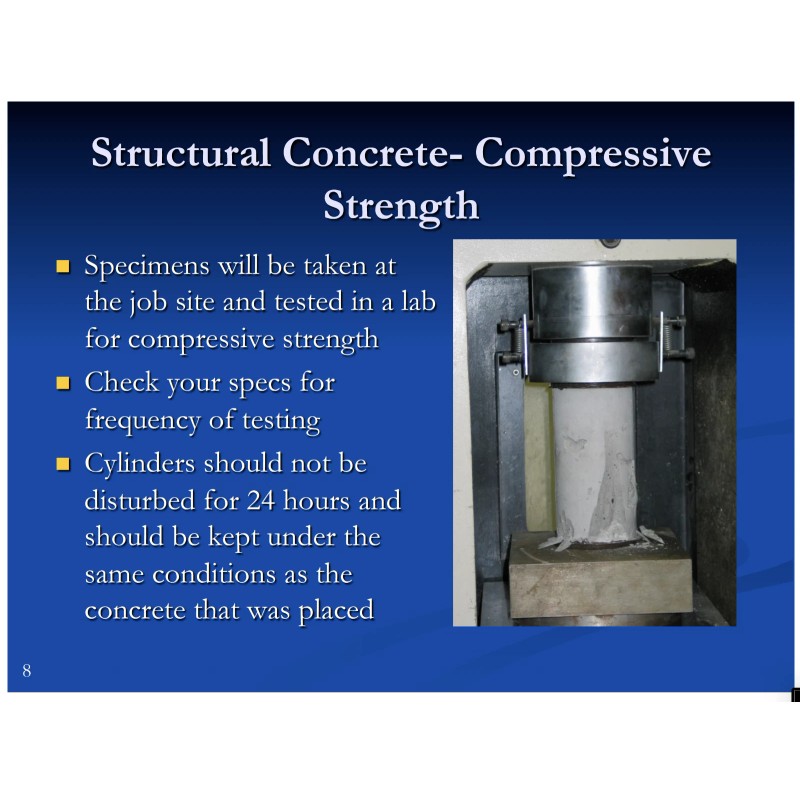
Structural Concrete- Compressive Strength
Specimens will be taken at the job site and tested in a lab for compressive strength
Check your specs for frequency of testing
Cylinders should not be disturbed for 24 hours and should be kept under the same conditions as the concrete that was placed
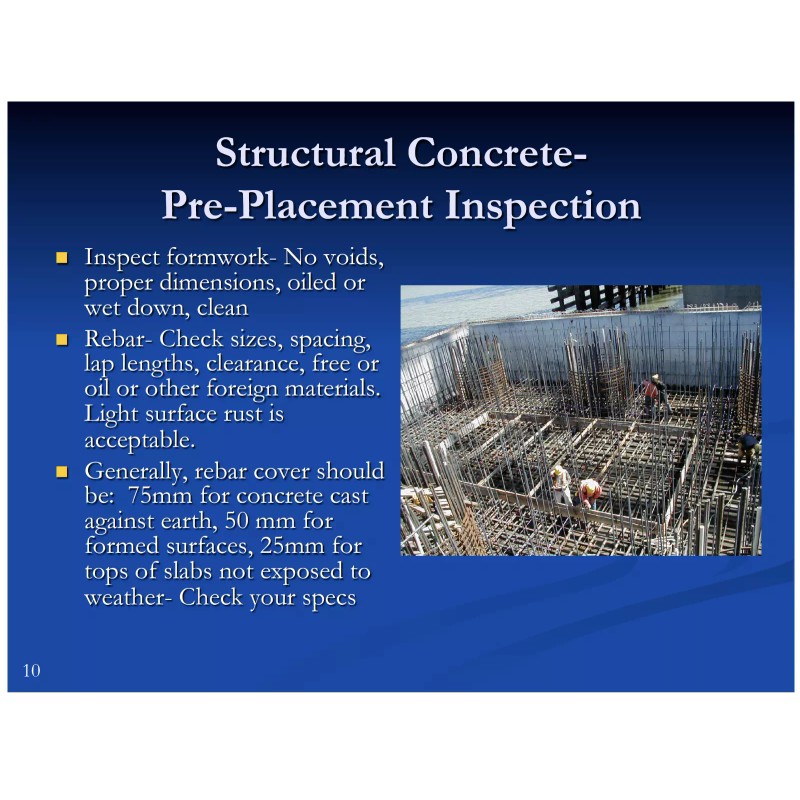
Structural Concrete- Pre-Placement Inspection
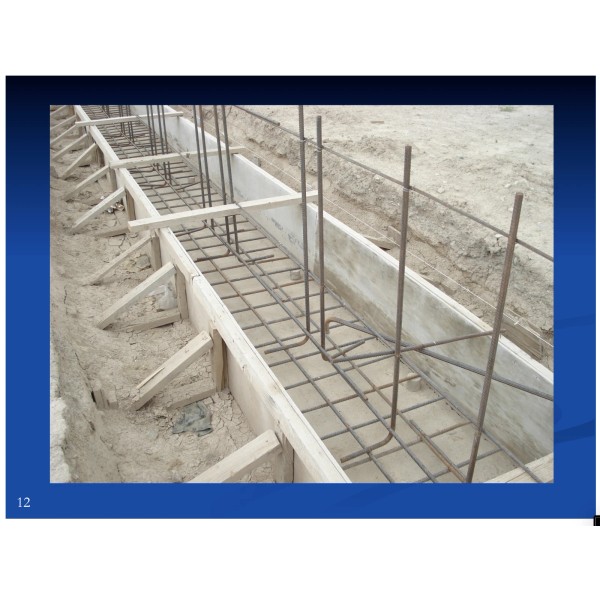
Inspect formwork- No voids, proper dimensions, oiled or wet down, clean
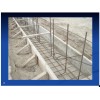
Rebar- Check sizes, spacing, lap lengths, clearance, free or oil or other foreign materials. Light surface rust is acceptable.
Generally, rebar cover should be: 75mm for concrete cast against earth, 50 mm for formed surfaces, 25mm for tops of slabs not exposed to weather- Check your specs
Structural Concrete- Pre-Placement Inspection
Joints- Check location and construction of joints- Control joints, expansion joints, construction joints.
Smooth dowels in control joints should be level & square to the joint. Often, one end is required to be painted and/or greased.
Plumbing- Sleeves, pipes, etc
Electrical- Conduit, sleeves, etc
Other- Anchor bolts, block outs, water stops, etc
Chamfer strips for exposed corners
Structural Concrete- Vapor Barrier
Generally, designers require a polyethylene vapor barrier below slabs on grade (SOG’s), to prevent water vapor from permeating the concrete slab
Usually the requirement is a 0.15mm polyethylene sheet, overlapped at least 30cm at the joints.
Punctured areas should be overlaid with new polyethylene prior to concrete placement
Care must be taken to avoid damaging the barrier during placement
Structural Concrete- Capillary Water Barrier
Generally, designers require a capillary water barrier below the vapor barrier for slabs on grade
Capillary water barriers usually consist of a poorly graded crushed rock or gravel, “poorly graded” refers to fairly uniform gradation that has voids and allows water to easily pass through
If sharp edges of crushed rock pose a risk of puncture to the vapor barrier, some specs allow a layer of sand on top to protect the vapor barrier- Check your specs
Structural Concrete- Placing
Concrete should not be placed on mud or standing water
Surfaces to receive the concrete (forms, rebar, etc.) must be at least 5C
On USACE projects, any concrete with a thickness of 10cm or deeper must be properly vibrated
Vibrator should be inserted and removed vertically, not dragged horizontally
Concrete should not be allowed to drop more than 1.8 meters
Except for slabs, concrete should be deposited in layers of not more than 30cm and each layer vibrated
Structural Concrete- Placing
Concrete should be deposited as close to it’s final position as possible
Concrete should not be allowed to drop more than 1.8 meters
Concrete should be placed in a manner to avoid “cold joints”
Immediately after placing, concrete should be screeded to proper elevation
Structural Concrete- Finishing
After screeding, concrete should be “bull-floated” before bleedwater is present on top
If required by the design, troweling occurs after bleedwater has disappeared and concrete has partially hardened
Exposed edges may be required to be edged with an edging tool for attractive appearance
Structural Concrete-Curing
Immediately after placement, concrete shall be protected from premature drying, extremes in temperatures, rapid temperature change, mechanical injury and damage from rain and flowing water for the duration of the curing period.
Check specs for length of curing period
During curing period the concrete must be kept wet- burlap, immersion, etc
Structural Concrete-Curing
Temperature of concrete must be kept above 5C during curing period
Contractor is required to monitor curing with periodic inspections and corrective action
Curing is VERY important, especially in the hot dry conditions of Afghanistan
Structural Concrete- Saw Cut Joints
If the contract requires sawcut joints, sawcutting should be done as soon as possible without spalling the concrete or tearing out the coarse aggregate
If sawcutting is done too late, uncontrolled cracking may occur
Structural Concrete-Formwork
Forms shall be mortar tight, properly aligned and adequately supported to produce concrete surfaces meeting the surface requirements specified in the contract- Check your spec for tolerances
USACE specs allow the soil to be used as forms of concrete that won’t be visible, as long as the soil is strong enough to hold a vertical face
Check dimensions, plumbness, elevation, straightness, etc.
Formwork for exposed concrete should be inspected for general appearance and condition, clean, & oiled with a form realeasing agent; the concrete will only look as well as the surface of the forms
Structural Concrete-Form Removal
Forms should be removed carefully to prevent damage to the new concrete
Generally, vertical forms may be removed after 24 hours, if the concrete is of sufficient strength to support itself
Generally, supporting forms of beams, elevated slabs, windows, doors, etc. may be removed after concrete has reached 70% of it’s design compressive strength.
Concrete must be inspected after form removal and deficiencies repaired per the requirements of the specs (honeycombs, etc.)
Reinforcing Steel
Generally, designers base their design on reinforcing steel yield strength of 420 MPA
Contractors must submit their rebar with certification of the yield strength of the steel
Contractors should also submit “mill certificates” showing the results of testing from the factory for the steel used by the contractor.
Reinforcing Steel
If the design drawings do not include enough detail to fabricate the rebar and install the rebar, shop drawings should be submitted for review showing lengths, lap lengths, bending details, etc.
Structural reinforcement should be deformed (not smooth)
Considerations during inspection: size, spacing, splices, cover, free of loose rust, oil, support, etc.
Reinforcing steel should be tied together securely with steel wire of 1.6mm diameter or larger
Masonry- CMU
CMU- Concrete Masonry Unit (concrete block)
Contractor must submit test results showing that the CMU they plan to use complies with the compressive strength requirements.
Generally, CMU on USACE projects must comply with ASTM C 90
Masonry- CMU ASTM C 90 Requirements
Sizes- ASTM C 90 specifies thickness of block
ASTM C 90 requires that the average compressive strength of three CMU tested must be 13.1 MPA (1900 PSI) or greater, with no specimen falling below 11.7 MPA (1700 PSI)
ASTM C 140 specifies that actual procedure for testing, frequency of testing, etc.
Masonry- CMU Mortar
Mortar- Generally required to have a compressive strength of 13.7 MPA (140 kg/cm2)
The project specifications may give a mix design, or the contractor may have to submit one- check your specs
Generally, compressive strength of mortar is tested ASTM C 109, using small cubes.
Mortar should be mixed in a mixer for no less than 3 minutes, and no more than 5 minutes
Masonry- CMU Mortar
Ingredients should be accurately measured by volume using measuring boxes, enough water added to make the mortar workable
Any mortar not used within 2-1/2 hours after mixing must be discarded
Mortar that will be exposed on the final construction should have tooled joints (concave)
Masonry- CMU Grout
Generally, grout is required to have a 28 day minimum compressive strength of 14 MPA- but check your specs, as it may vary
Generally, grout should have a slump of 20-25 cm
Grout mixed on the site should be mixed for at least 5 minutes
Grout should be vibrated once it is deposited in the CMU cells
Masonry- CMU Grout
CMU cells should be inspected prior to grout placement to make sure they are not full of mortar droppings and foreign material.
Grout that has not been used within 1-1/2 hours after mixing must be discarded
Masonry- Joints
Check drawings for masonry joint locations, and details of construction
Rebar runs through some joints and not through others, familiarity with the drawing details are critical to proper QA surveillance
Masonry- Steel Reinforcement
Vertical reinforcement should be imbedded in the concrete footing or slab supporting the wall
Check drawings for size, spacing and lap length, a common lap length is 40 bar diameters
Drawing details often require extra rebar at corners, doors & windows
Check specifications for required clearances from CMU, commonly it is 13mm
Check drawings and specs for requirement of horizontal reinforcing- size and spacing
Masonry- Misc. QA Considerations
Some common miscellaneous considerations for QA’s related to masonry
- Tolerances. Check the specifications for allowable tolerances for straightness and plumbness
- “Running Bond” pattern.
- Temperatures. See specifications for temperature limitations of masonry work
- Bond beams, lintels, etc
Basic Building Construction II
Finishes: Cementious Plaster, Terrazzo Tile, Ceramic Tile
Cementitious Plaster
Mixture of cement, sand, water and sometimes lime (to increase workability and decrease permeability)
Also known as “stucco” when used on exterior walls
4 parts sand: 1 part cement: 3/4-1.5 part lime for first and second coats.
3 parts sand; 1 part cement: ¾-1.5 parts lime for finish coat (per ASTM C926)
Plaster should be mechanically mixed for 3-5 minutes
Cementitious Plaster
Generally applied in three coats:
First coat- “Splash Coat”: Very high slump, promotes bonding between surface and the plaster
Second Coat- “Scratch Coat”: Many designs require 1 cm thickness, once it starts hardening the surface is scratched horizontally for bonding with the next coat
Third coat- “Finish Coat”: Usually 1 cm thick, must have straight, plumb, smooth etc.
Cementitious Plaster
Surface Preparation- Smooth concrete surfaces should be roughened prior to placing splash coat
Surfaces should be clean and free of dirt and loose materials
Temperatures should be above 5 C for 48 hours prior to plaster application
Generally, the contracts require the use of stop beads & corner beads. Check YOUR contract.
Cementitious Plaster
Curing- The specs for many of our contracts require scratch coat to be moist cured for 72 hours and finish coat for 48 hours minimum
Plaster Stop Bead
Scratch Coat & Finish Coat
Corner Bead with Finish Coat on Right Side, CMU on left side
Corner Beads Installed on Sides of Windows, Stop Bead at Bottom
Terrazzo Tile
Most designs at AED use a damp mortar leveling bed on top of concrete floor
Floor should be swept clean and free of trash and loose material
Tile should be layed out from centerline of room. Adjustments may be made to avoid thin tiles at the edges
If there are floor drains, the tile should be sloped toward the drain
Terrazzo Tile
String lines should be used for correct elevation and alignment
Once tiles are set, a grout consisting of white cement & marble dust is used to fill the joints
Tiles are then ground smooth. This may be done in 3-4 steps with progressively smoother stones
Finally, tiles are sealed and polished
Terrazzo Tile Set on a Damp Mortar Bed
White Cement Grout
Grinding the Tile
Ceramic Tile
Temperatures of 10ºC should be maintained during tile installation and for 7 days after completion
A pre-mixed adhesive mortar should be used, manufactured specifically for use with ceramic tile
Adhesive mortar should be applied with a notched trowel
Ceramic Tile
Tile should be layed out from center line of wall, some adjustments can be made to avoid the use of very thin tiles on the sides
“Jointing crosses” should be used to maintain consistent joint size
A pre-mixed grout should be used for filling of joints. It is forced into the joints with a rubber trowel. After 15-30 minutes, the tile should be cleaned with a damp sponge. When finished the joint should be concave.
Ceramic Wall Tile Being Installed Note the mortar was applied with notched trowel, jointing crosses being used
Questions?
On Sep-13-09 at 06:16:14 PDT, seller added the following information:
| Isin: | IKYVF80LDQWZ |
|---|
Out of Stock
In Stock
Backordered
Out of Stock


IBspot Buyer Protection
Shop confidently on IBspot, receive your item as described or your money back for eligible orders. Learn Program Terms
Product Overview
Thank you!
If you do not wish to have your item(s) delivered on data disc(s), I can provide them on a flash drive and other means as well. Just let me know if a disc does not work for you and we can discuss delivery by other methods.
COMBINING SHIPPING COSTS
Are you purchasing multiple items? I will: a) combine all invoices before payment and charge shipping equivalent to one item, or b) refund all shipping costs in excess of one item after payment.
All derivative (i.e. change in media; by compilation) work from this underlying U.S. Government public domain/public release data is COPYRIGHT © GOVPUBS$3.00 first class shipping in U.S.
Includes the Adobe Acrobat Reader for reading and printing publications.
Numerous illustrations and matrices.
Contains the following key public domain (not copyrighted) U.S. Government publication(s) on one CD-ROM in both Microsoft PowerPoint and Adobe Acrobat PDF file formats:
TITLE:
Basic Building Construction I and II, 64 slides
SLIDE TOPICS, SUBTOPICS and CONTENTS:
Basic Building Construction I
Structural Concrete, Reinforcing Steel & CMU Masonry
Structural Concrete
Mix Design- Contractor submits the mix design he proposes to use. It shows evidence from previous testing of the strength of the mix. It is reviewed by the government engineers and approved or disapproved.
Designer specifies required strength in the specifications- Usually 28 MPa at 28 days.
Concrete- Temperature
Field Testing of Concrete- Temperature
Temperature- ACI requires temperature to be between 5 C and 32 C. If concrete temp is 5C-29C then the concrete has to be placed within 90 minutes of batching. If concrete temp is 30-32 C then it must be placed within 45 minutes of batching. If the concrete is more than 32 C then it cannot be used, and QC Manager should reject it.
Check your projects specifications, humidity may affect allowable temperatures.
Structural Concrete- Slump
Normally, on USACE projects the slump of the concrete must be between 25mm & 100mm
Check specifications for frequency of slump testing
Structural Concrete- Air
Some contracts require concrete to have air entrainment
Generally the required air entrainment is 3-5%
The purpose of air entrainment is to prevent spalling of concrete due to freeze-thaw cycles
Important for concrete that is exposed to the weather
Structural Concrete- Compressive Strength
Specimens will be taken at the job site and tested in a lab for compressive strength
Check your specs for frequency of testing
Cylinders should not be disturbed for 24 hours and should be kept under the same conditions as the concrete that was placed
Structural Concrete- Pre-Placement Inspection
Inspect formwork- No voids, proper dimensions, oiled or wet down, clean
Rebar- Check sizes, spacing, lap lengths, clearance, free or oil or other foreign materials. Light surface rust is acceptable.
Generally, rebar cover should be: 75mm for concrete cast against earth, 50 mm for formed surfaces, 25mm for tops of slabs not exposed to weather- Check your specs
Structural Concrete- Pre-Placement Inspection
Joints- Check location and construction of joints- Control joints, expansion joints, construction joints.
Smooth dowels in control joints should be level & square to the joint. Often, one end is required to be painted and/or greased.
Plumbing- Sleeves, pipes, etc
Electrical- Conduit, sleeves, etc
Other- Anchor bolts, block outs, water stops, etc
Chamfer strips for exposed corners
Structural Concrete- Vapor Barrier
Generally, designers require a polyethylene vapor barrier below slabs on grade (SOG’s), to prevent water vapor from permeating the concrete slab
Usually the requirement is a 0.15mm polyethylene sheet, overlapped at least 30cm at the joints.
Punctured areas should be overlaid with new polyethylene prior to concrete placement
Care must be taken to avoid damaging the barrier during placement
Structural Concrete- Capillary Water Barrier
Generally, designers require a capillary water barrier below the vapor barrier for slabs on grade
Capillary water barriers usually consist of a poorly graded crushed rock or gravel, “poorly graded” refers to fairly uniform gradation that has voids and allows water to easily pass through
If sharp edges of crushed rock pose a risk of puncture to the vapor barrier, some specs allow a layer of sand on top to protect the vapor barrier- Check your specs
Structural Concrete- Placing
Concrete should not be placed on mud or standing water
Surfaces to receive the concrete (forms, rebar, etc.) must be at least 5C
On USACE projects, any concrete with a thickness of 10cm or deeper must be properly vibrated
Vibrator should be inserted and removed vertically, not dragged horizontally
Concrete should not be allowed to drop more than 1.8 meters
Except for slabs, concrete should be deposited in layers of not more than 30cm and each layer vibrated
Structural Concrete- Placing
Concrete should be deposited as close to it’s final position as possible
Concrete should not be allowed to drop more than 1.8 meters
Concrete should be placed in a manner to avoid “cold joints”
Immediately after placing, concrete should be screeded to proper elevation
Structural Concrete- Finishing
After screeding, concrete should be “bull-floated” before bleedwater is present on top
If required by the design, troweling occurs after bleedwater has disappeared and concrete has partially hardened
Exposed edges may be required to be edged with an edging tool for attractive appearance
Structural Concrete-Curing
Immediately after placement, concrete shall be protected from premature drying, extremes in temperatures, rapid temperature change, mechanical injury and damage from rain and flowing water for the duration of the curing period.
Check specs for length of curing period
During curing period the concrete must be kept wet- burlap, immersion, etc
Structural Concrete-Curing
Temperature of concrete must be kept above 5C during curing period
Contractor is required to monitor curing with periodic inspections and corrective action
Curing is VERY important, especially in the hot dry conditions of Afghanistan
Structural Concrete- Saw Cut Joints
If the contract requires sawcut joints, sawcutting should be done as soon as possible without spalling the concrete or tearing out the coarse aggregate
If sawcutting is done too late, uncontrolled cracking may occur
Structural Concrete-Formwork
Forms shall be mortar tight, properly aligned and adequately supported to produce concrete surfaces meeting the surface requirements specified in the contract- Check your spec for tolerances
USACE specs allow the soil to be used as forms of concrete that won’t be visible, as long as the soil is strong enough to hold a vertical face
Check dimensions, plumbness, elevation, straightness, etc.
Formwork for exposed concrete should be inspected for general appearance and condition, clean, & oiled with a form realeasing agent; the concrete will only look as well as the surface of the forms
Structural Concrete-Form Removal
Forms should be removed carefully to prevent damage to the new concrete
Generally, vertical forms may be removed after 24 hours, if the concrete is of sufficient strength to support itself
Generally, supporting forms of beams, elevated slabs, windows, doors, etc. may be removed after concrete has reached 70% of it’s design compressive strength.
Concrete must be inspected after form removal and deficiencies repaired per the requirements of the specs (honeycombs, etc.)
Reinforcing Steel
Generally, designers base their design on reinforcing steel yield strength of 420 MPA
Contractors must submit their rebar with certification of the yield strength of the steel
Contractors should also submit “mill certificates” showing the results of testing from the factory for the steel used by the contractor.
Reinforcing Steel
If the design drawings do not include enough detail to fabricate the rebar and install the rebar, shop drawings should be submitted for review showing lengths, lap lengths, bending details, etc.
Structural reinforcement should be deformed (not smooth)
Considerations during inspection: size, spacing, splices, cover, free of loose rust, oil, support, etc.
Reinforcing steel should be tied together securely with steel wire of 1.6mm diameter or larger
Masonry- CMU
CMU- Concrete Masonry Unit (concrete block)
Contractor must submit test results showing that the CMU they plan to use complies with the compressive strength requirements.
Generally, CMU on USACE projects must comply with ASTM C 90
Masonry- CMU ASTM C 90 Requirements
Sizes- ASTM C 90 specifies thickness of block
ASTM C 90 requires that the average compressive strength of three CMU tested must be 13.1 MPA (1900 PSI) or greater, with no specimen falling below 11.7 MPA (1700 PSI)
ASTM C 140 specifies that actual procedure for testing, frequency of testing, etc.
Masonry- CMU Mortar
Mortar- Generally required to have a compressive strength of 13.7 MPA (140 kg/cm2)
The project specifications may give a mix design, or the contractor may have to submit one- check your specs
Generally, compressive strength of mortar is tested ASTM C 109, using small cubes.
Mortar should be mixed in a mixer for no less than 3 minutes, and no more than 5 minutes
Masonry- CMU Mortar
Ingredients should be accurately measured by volume using measuring boxes, enough water added to make the mortar workable
Any mortar not used within 2-1/2 hours after mixing must be discarded
Mortar that will be exposed on the final construction should have tooled joints (concave)
Masonry- CMU Grout
Generally, grout is required to have a 28 day minimum compressive strength of 14 MPA- but check your specs, as it may vary
Generally, grout should have a slump of 20-25 cm
Grout mixed on the site should be mixed for at least 5 minutes
Grout should be vibrated once it is deposited in the CMU cells
Masonry- CMU Grout
CMU cells should be inspected prior to grout placement to make sure they are not full of mortar droppings and foreign material.
Grout that has not been used within 1-1/2 hours after mixing must be discarded
Masonry- Joints
Check drawings for masonry joint locations, and details of construction
Rebar runs through some joints and not through others, familiarity with the drawing details are critical to proper QA surveillance
Masonry- Steel Reinforcement
Vertical reinforcement should be imbedded in the concrete footing or slab supporting the wall
Check drawings for size, spacing and lap length, a common lap length is 40 bar diameters
Drawing details often require extra rebar at corners, doors & windows
Check specifications for required clearances from CMU, commonly it is 13mm
Check drawings and specs for requirement of horizontal reinforcing- size and spacing
Masonry- Misc. QA Considerations
Some common miscellaneous considerations for QA’s related to masonry
- Tolerances. Check the specifications for allowable tolerances for straightness and plumbness
- “Running Bond” pattern.
- Temperatures. See specifications for temperature limitations of masonry work
- Bond beams, lintels, etc
Basic Building Construction II
Finishes: Cementious Plaster, Terrazzo Tile, Ceramic Tile
Cementitious Plaster
Mixture of cement, sand, water and sometimes lime (to increase workability and decrease permeability)
Also known as “stucco” when used on exterior walls
4 parts sand: 1 part cement: 3/4-1.5 part lime for first and second coats.
3 parts sand; 1 part cement: ¾-1.5 parts lime for finish coat (per ASTM C926)
Plaster should be mechanically mixed for 3-5 minutes
Cementitious Plaster
Generally applied in three coats:
First coat- “Splash Coat”: Very high slump, promotes bonding between surface and the plaster
Second Coat- “Scratch Coat”: Many designs require 1 cm thickness, once it starts hardening the surface is scratched horizontally for bonding with the next coat
Third coat- “Finish Coat”: Usually 1 cm thick, must have straight, plumb, smooth etc.
Cementitious Plaster
Surface Preparation- Smooth concrete surfaces should be roughened prior to placing splash coat
Surfaces should be clean and free of dirt and loose materials
Temperatures should be above 5 C for 48 hours prior to plaster application
Generally, the contracts require the use of stop beads & corner beads. Check YOUR contract.
Cementitious Plaster
Curing- The specs for many of our contracts require scratch coat to be moist cured for 72 hours and finish coat for 48 hours minimum
Plaster Stop Bead
Scratch Coat & Finish Coat
Corner Bead with Finish Coat on Right Side, CMU on left side
Corner Beads Installed on Sides of Windows, Stop Bead at Bottom
Terrazzo Tile
Most designs at AED use a damp mortar leveling bed on top of concrete floor
Floor should be swept clean and free of trash and loose material
Tile should be layed out from centerline of room. Adjustments may be made to avoid thin tiles at the edges
If there are floor drains, the tile should be sloped toward the drain
Terrazzo Tile
String lines should be used for correct elevation and alignment
Once tiles are set, a grout consisting of white cement & marble dust is used to fill the joints
Tiles are then ground smooth. This may be done in 3-4 steps with progressively smoother stones
Finally, tiles are sealed and polished
Terrazzo Tile Set on a Damp Mortar Bed
White Cement Grout
Grinding the Tile
Ceramic Tile
Temperatures of 10ºC should be maintained during tile installation and for 7 days after completion
A pre-mixed adhesive mortar should be used, manufactured specifically for use with ceramic tile
Adhesive mortar should be applied with a notched trowel
Ceramic Tile
Tile should be layed out from center line of wall, some adjustments can be made to avoid the use of very thin tiles on the sides
“Jointing crosses” should be used to maintain consistent joint size
A pre-mixed grout should be used for filling of joints. It is forced into the joints with a rubber trowel. After 15-30 minutes, the tile should be cleaned with a damp sponge. When finished the joint should be concave.
Ceramic Wall Tile Being Installed Note the mortar was applied with notched trowel, jointing crosses being used
Questions?
On Sep-13-09 at 06:16:14 PDT, seller added the following information:
| Isin: | IKYVF80LDQWZ |
|---|
Thank you!
If you do not wish to have your item(s) delivered on data disc(s), I can provide them on a flash drive and other means as well. Just let me know if a disc does not work for you and we can discuss delivery by other methods.
COMBINING SHIPPING COSTS
Are you purchasing multiple items? I will: a) combine all invoices before payment and charge shipping equivalent to one item, or b) refund all shipping costs in excess of one item after payment.
All derivative (i.e. change in media; by compilation) work from this underlying U.S. Government public domain/public release data is COPYRIGHT © GOVPUBS$3.00 first class shipping in U.S.
Includes the Adobe Acrobat Reader for reading and printing publications.
Numerous illustrations and matrices.
Contains the following key public domain (not copyrighted) U.S. Government publication(s) on one CD-ROM in both Microsoft PowerPoint and Adobe Acrobat PDF file formats:
TITLE:
Basic Building Construction I and II, 64 slides
SLIDE TOPICS, SUBTOPICS and CONTENTS:
Basic Building Construction I
Structural Concrete, Reinforcing Steel & CMU Masonry
Structural Concrete
Mix Design- Contractor submits the mix design he proposes to use. It shows evidence from previous testing of the strength of the mix. It is reviewed by the government engineers and approved or disapproved.
Designer specifies required strength in the specifications- Usually 28 MPa at 28 days.
Concrete- Temperature
Field Testing of Concrete- Temperature
Temperature- ACI requires temperature to be between 5 C and 32 C. If concrete temp is 5C-29C then the concrete has to be placed within 90 minutes of batching. If concrete temp is 30-32 C then it must be placed within 45 minutes of batching. If the concrete is more than 32 C then it cannot be used, and QC Manager should reject it.
Check your projects specifications, humidity may affect allowable temperatures.
Structural Concrete- Slump
Normally, on USACE projects the slump of the concrete must be between 25mm & 100mm
Check specifications for frequency of slump testing
Structural Concrete- Air
Some contracts require concrete to have air entrainment
Generally the required air entrainment is 3-5%
The purpose of air entrainment is to prevent spalling of concrete due to freeze-thaw cycles
Important for concrete that is exposed to the weather
Structural Concrete- Compressive Strength
Specimens will be taken at the job site and tested in a lab for compressive strength
Check your specs for frequency of testing
Cylinders should not be disturbed for 24 hours and should be kept under the same conditions as the concrete that was placed
Structural Concrete- Pre-Placement Inspection
Inspect formwork- No voids, proper dimensions, oiled or wet down, clean
Rebar- Check sizes, spacing, lap lengths, clearance, free or oil or other foreign materials. Light surface rust is acceptable.
Generally, rebar cover should be: 75mm for concrete cast against earth, 50 mm for formed surfaces, 25mm for tops of slabs not exposed to weather- Check your specs
Structural Concrete- Pre-Placement Inspection
Joints- Check location and construction of joints- Control joints, expansion joints, construction joints.
Smooth dowels in control joints should be level & square to the joint. Often, one end is required to be painted and/or greased.
Plumbing- Sleeves, pipes, etc
Electrical- Conduit, sleeves, etc
Other- Anchor bolts, block outs, water stops, etc
Chamfer strips for exposed corners
Structural Concrete- Vapor Barrier
Generally, designers require a polyethylene vapor barrier below slabs on grade (SOG’s), to prevent water vapor from permeating the concrete slab
Usually the requirement is a 0.15mm polyethylene sheet, overlapped at least 30cm at the joints.
Punctured areas should be overlaid with new polyethylene prior to concrete placement
Care must be taken to avoid damaging the barrier during placement
Structural Concrete- Capillary Water Barrier
Generally, designers require a capillary water barrier below the vapor barrier for slabs on grade
Capillary water barriers usually consist of a poorly graded crushed rock or gravel, “poorly graded” refers to fairly uniform gradation that has voids and allows water to easily pass through
If sharp edges of crushed rock pose a risk of puncture to the vapor barrier, some specs allow a layer of sand on top to protect the vapor barrier- Check your specs
Structural Concrete- Placing
Concrete should not be placed on mud or standing water
Surfaces to receive the concrete (forms, rebar, etc.) must be at least 5C
On USACE projects, any concrete with a thickness of 10cm or deeper must be properly vibrated
Vibrator should be inserted and removed vertically, not dragged horizontally
Concrete should not be allowed to drop more than 1.8 meters
Except for slabs, concrete should be deposited in layers of not more than 30cm and each layer vibrated
Structural Concrete- Placing
Concrete should be deposited as close to it’s final position as possible
Concrete should not be allowed to drop more than 1.8 meters
Concrete should be placed in a manner to avoid “cold joints”
Immediately after placing, concrete should be screeded to proper elevation
Structural Concrete- Finishing
After screeding, concrete should be “bull-floated” before bleedwater is present on top
If required by the design, troweling occurs after bleedwater has disappeared and concrete has partially hardened
Exposed edges may be required to be edged with an edging tool for attractive appearance
Structural Concrete-Curing
Immediately after placement, concrete shall be protected from premature drying, extremes in temperatures, rapid temperature change, mechanical injury and damage from rain and flowing water for the duration of the curing period.
Check specs for length of curing period
During curing period the concrete must be kept wet- burlap, immersion, etc
Structural Concrete-Curing
Temperature of concrete must be kept above 5C during curing period
Contractor is required to monitor curing with periodic inspections and corrective action
Curing is VERY important, especially in the hot dry conditions of Afghanistan
Structural Concrete- Saw Cut Joints
If the contract requires sawcut joints, sawcutting should be done as soon as possible without spalling the concrete or tearing out the coarse aggregate
If sawcutting is done too late, uncontrolled cracking may occur
Structural Concrete-Formwork
Forms shall be mortar tight, properly aligned and adequately supported to produce concrete surfaces meeting the surface requirements specified in the contract- Check your spec for tolerances
USACE specs allow the soil to be used as forms of concrete that won’t be visible, as long as the soil is strong enough to hold a vertical face
Check dimensions, plumbness, elevation, straightness, etc.
Formwork for exposed concrete should be inspected for general appearance and condition, clean, & oiled with a form realeasing agent; the concrete will only look as well as the surface of the forms
Structural Concrete-Form Removal
Forms should be removed carefully to prevent damage to the new concrete
Generally, vertical forms may be removed after 24 hours, if the concrete is of sufficient strength to support itself
Generally, supporting forms of beams, elevated slabs, windows, doors, etc. may be removed after concrete has reached 70% of it’s design compressive strength.
Concrete must be inspected after form removal and deficiencies repaired per the requirements of the specs (honeycombs, etc.)
Reinforcing Steel
Generally, designers base their design on reinforcing steel yield strength of 420 MPA
Contractors must submit their rebar with certification of the yield strength of the steel
Contractors should also submit “mill certificates” showing the results of testing from the factory for the steel used by the contractor.
Reinforcing Steel
If the design drawings do not include enough detail to fabricate the rebar and install the rebar, shop drawings should be submitted for review showing lengths, lap lengths, bending details, etc.
Structural reinforcement should be deformed (not smooth)
Considerations during inspection: size, spacing, splices, cover, free of loose rust, oil, support, etc.
Reinforcing steel should be tied together securely with steel wire of 1.6mm diameter or larger
Masonry- CMU
CMU- Concrete Masonry Unit (concrete block)
Contractor must submit test results showing that the CMU they plan to use complies with the compressive strength requirements.
Generally, CMU on USACE projects must comply with ASTM C 90
Masonry- CMU ASTM C 90 Requirements
Sizes- ASTM C 90 specifies thickness of block
ASTM C 90 requires that the average compressive strength of three CMU tested must be 13.1 MPA (1900 PSI) or greater, with no specimen falling below 11.7 MPA (1700 PSI)
ASTM C 140 specifies that actual procedure for testing, frequency of testing, etc.
Masonry- CMU Mortar
Mortar- Generally required to have a compressive strength of 13.7 MPA (140 kg/cm2)
The project specifications may give a mix design, or the contractor may have to submit one- check your specs
Generally, compressive strength of mortar is tested ASTM C 109, using small cubes.
Mortar should be mixed in a mixer for no less than 3 minutes, and no more than 5 minutes
Masonry- CMU Mortar
Ingredients should be accurately measured by volume using measuring boxes, enough water added to make the mortar workable
Any mortar not used within 2-1/2 hours after mixing must be discarded
Mortar that will be exposed on the final construction should have tooled joints (concave)
Masonry- CMU Grout
Generally, grout is required to have a 28 day minimum compressive strength of 14 MPA- but check your specs, as it may vary
Generally, grout should have a slump of 20-25 cm
Grout mixed on the site should be mixed for at least 5 minutes
Grout should be vibrated once it is deposited in the CMU cells
Masonry- CMU Grout
CMU cells should be inspected prior to grout placement to make sure they are not full of mortar droppings and foreign material.
Grout that has not been used within 1-1/2 hours after mixing must be discarded
Masonry- Joints
Check drawings for masonry joint locations, and details of construction
Rebar runs through some joints and not through others, familiarity with the drawing details are critical to proper QA surveillance
Masonry- Steel Reinforcement
Vertical reinforcement should be imbedded in the concrete footing or slab supporting the wall
Check drawings for size, spacing and lap length, a common lap length is 40 bar diameters
Drawing details often require extra rebar at corners, doors & windows
Check specifications for required clearances from CMU, commonly it is 13mm
Check drawings and specs for requirement of horizontal reinforcing- size and spacing
Masonry- Misc. QA Considerations
Some common miscellaneous considerations for QA’s related to masonry
- Tolerances. Check the specifications for allowable tolerances for straightness and plumbness
- “Running Bond” pattern.
- Temperatures. See specifications for temperature limitations of masonry work
- Bond beams, lintels, etc
Basic Building Construction II
Finishes: Cementious Plaster, Terrazzo Tile, Ceramic Tile
Cementitious Plaster
Mixture of cement, sand, water and sometimes lime (to increase workability and decrease permeability)
Also known as “stucco” when used on exterior walls
4 parts sand: 1 part cement: 3/4-1.5 part lime for first and second coats.
3 parts sand; 1 part cement: ¾-1.5 parts lime for finish coat (per ASTM C926)
Plaster should be mechanically mixed for 3-5 minutes
Cementitious Plaster
Generally applied in three coats:
First coat- “Splash Coat”: Very high slump, promotes bonding between surface and the plaster
Second Coat- “Scratch Coat”: Many designs require 1 cm thickness, once it starts hardening the surface is scratched horizontally for bonding with the next coat
Third coat- “Finish Coat”: Usually 1 cm thick, must have straight, plumb, smooth etc.
Cementitious Plaster
Surface Preparation- Smooth concrete surfaces should be roughened prior to placing splash coat
Surfaces should be clean and free of dirt and loose materials
Temperatures should be above 5 C for 48 hours prior to plaster application
Generally, the contracts require the use of stop beads & corner beads. Check YOUR contract.
Cementitious Plaster
Curing- The specs for many of our contracts require scratch coat to be moist cured for 72 hours and finish coat for 48 hours minimum
Plaster Stop Bead
Scratch Coat & Finish Coat
Corner Bead with Finish Coat on Right Side, CMU on left side
Corner Beads Installed on Sides of Windows, Stop Bead at Bottom
Terrazzo Tile
Most designs at AED use a damp mortar leveling bed on top of concrete floor
Floor should be swept clean and free of trash and loose material
Tile should be layed out from centerline of room. Adjustments may be made to avoid thin tiles at the edges
If there are floor drains, the tile should be sloped toward the drain
Terrazzo Tile
String lines should be used for correct elevation and alignment
Once tiles are set, a grout consisting of white cement & marble dust is used to fill the joints
Tiles are then ground smooth. This may be done in 3-4 steps with progressively smoother stones
Finally, tiles are sealed and polished
Terrazzo Tile Set on a Damp Mortar Bed
White Cement Grout
Grinding the Tile
Ceramic Tile
Temperatures of 10ºC should be maintained during tile installation and for 7 days after completion
A pre-mixed adhesive mortar should be used, manufactured specifically for use with ceramic tile
Adhesive mortar should be applied with a notched trowel
Ceramic Tile
Tile should be layed out from center line of wall, some adjustments can be made to avoid the use of very thin tiles on the sides
“Jointing crosses” should be used to maintain consistent joint size
A pre-mixed grout should be used for filling of joints. It is forced into the joints with a rubber trowel. After 15-30 minutes, the tile should be cleaned with a damp sponge. When finished the joint should be concave.
Ceramic Wall Tile Being Installed Note the mortar was applied with notched trowel, jointing crosses being used
Questions?
On Sep-13-09 at 06:16:14 PDT, seller added the following information:
Processing Time
- We process and ship orders Monday through Friday, excluding holidays.
- Most orders are processed within 1–3 business days, depending on product availability.
- Processing time does not include delivery time, which varies based on your location and the product’s shipping origin.
Shipping Coverage
We currently ship to addresses within the United States only.
Products may ship from:
- Our U.S. warehouses, or
- Our international fulfillment centers (including Korea, Japan, China, Australia, Mexico, Canada, the United Kingdom, and the EU).
Each product page clearly displays the “Ships From” location before checkout.
Shipping Methods & Estimated Delivery
| Shipping Method | Estimated Delivery | Cost |
|---|---|---|
| Free Shipping (US) | 5–10 business days | Free, available on eligible items |
| Standard Shipping (US to US by Item) | 5–10 business days | $6.50 for the first item, $2.00 each additional |
| Standard Shipping (From US Warehouse by Weight) | 3–7 business days | Starts at $6.50, increasing by $2 for every additional 4 oz (0.25 lb) up to 1 lb, then by $4 for each additional pound beyond 1 lb. |
| Extended Delivery (Ships from Overseas Warehouse) | 10–20 business days | $14.50 for the first item, $2.00 each additional |
Shipping costs vary by product weight, quantity and origin. Exact rates and delivery estimates are displayed on each product page and confirmed during checkout.
Free Shipping
We offer free standard shipping on select products or during promotional periods. Availability of free shipping will be displayed on the product page and at checkout.
Carriers
We primarily use USPS and UPS for U.S. deliveries. Items shipped from international warehouses may be handled by partner carriers depending on the country of origin.
Import Duties & Taxes
All import duties and taxes for goods imported into the United States are included in the product price. There are no hidden fees or additional charges at checkout.
Tracking & Notifications
Every order is fully trackable. You will receive a tracking number via email once your order ships. If your order ships in multiple packages, each package will have its own tracking number. If you don’t receive a shipping confirmation immediately, your order is still being processed and will arrive within the estimated timeframe shown at checkout.
You can track your shipment anytime using the Track Your Order page on our website.
Order Changes & Cancellations
If you need to modify or cancel an order, please contact our customer support team as soon as possible. Orders can only be canceled before they ship. Once shipped, cancellations are not possible, but you may request a return after the item is delivered.
Contact: support@ibspot.com
Item Not Received
If your tracking number shows “Delivered” but you haven’t received your package:
- Check with your local USPS or UPS office.
- Confirm that the shipping address provided was correct.
- If the issue remains unresolved, contact support@ibspot.com for assistance.
Damaged or Lost Parcels
If your package arrives damaged or fails to arrive, please contact us immediately. For deliveries to P.O. boxes, ibspot is not responsible for damage caused by weather, temperature, or theft.
Customer Support
For any questions about shipping, tracking, or delivery, our customer support team is here to help.
Email: support@ibspot.com
We’re always happy to help.
Please read our policy carefully before making a purchase.
We aim to ensure every customer has a smooth and transparent experience with ibspot.com.
Order Cancellation Policy
Customers may request to cancel an order before it has been shipped.
Once the package has been shipped, cancellations are no longer possible; however, you may still request a return after receiving your order.
How to Request a Cancellation
You can contact us through:
- Email: support@ibspot.com
- Contact Form: Submit a request through our Contact Us page
Please submit your cancellation request as soon as possible after placing the order to allow us to process it before shipment.
Return Policy
We accept returns for most items within 30 days of delivery for a full refund.
To be eligible for a return:
- The item must be unused, in the same condition as received, and in its original packaging.
- A tracking number must be provided to confirm the return shipment.
Non-Returnable Items
Certain products cannot be returned, including:
- Perishable goods (for example, food, flowers, newspapers, magazines)
- Intimate or sanitary goods
- Hazardous materials or flammable liquids/gases
- Gift cards
- Downloadable software
- Some health and personal care items
Partial Refunds (If Applicable)
Partial refunds may be granted in specific situations, such as:
- Books with obvious signs of use
- Opened CDs, DVDs, software, or vinyl records
- Items not in their original condition, damaged, or missing parts not due to our error
- Items returned more than 30 days after delivery
How to Return an Item
To initiate a return, please contact us at support@ibspot.com with your order number and details about the product you wish to return.
Our team will provide you with return instructions and a prepaid return label.
Shipping Cost for Returns
Please contact us before returning any item.
We will provide a free return shipping label.
If a return is sent back without prior contact or without our provided label, we cannot be held responsible for return shipping costs.
For items valued over $75, we recommend using a trackable shipping service or purchasing shipping insurance.
We cannot guarantee that we will receive your returned item if shipped independently.
Refund Processing
Once your return is received and inspected:
- In-store returns are refunded to the original form of payment or issued as a gift card.
- Mail-in returns using our prepaid label are refunded to the original payment method within 3–5 business days after we receive your return.
Please allow:
- 5–7 business days for the return to reach our Returns Center.
- An additional 3–10 business days for your bank to post the refund to your account.
Damages, Issues & Claims
Please inspect your order immediately upon receipt.
If you receive a defective, damaged, or incorrect item, contact us right away at support@ibspot.com.
We’ll evaluate the issue promptly and make it right.
Product Claims
Before purchasing, please review product details carefully.
If there is a problem with your order upon arrival, visit our Support Center or contact us directly to arrange return shipping or replacement.
Exchanges
We do not process direct exchanges.
The fastest way to get what you need is to return the original item and place a new order once your return is accepted.
Return Address
IBSPOT Return Center
15 Sawmill Ln
Dover Plains, NY 12522
United States
Customer Support
Our support team is available 24/7 to assist with cancellations, returns, or general inquiries.
Email: support@ibspot.com
Contact Form: Contact Us page

Oops!
Sorry, it looks like some products are not available in selected quantity.